Wednesday, May 2, 2018

In Honor of Admiral Yuri Stark

So many owe him for their improved future, the opportunity to find freedom and to begin a new life outside the clutches of communist Russia.  Without a doubt, he exemplified one of the best Russian Naval Officers to represent the humanity of leadership instilled in the Russian Imperial Navy.  Admiral Stark was a largely unsung hero whose valuable contributions are being honored now.


            Russian Cemetery, St. Genevieve des Bois, south of Paris, France

                                          
                             Cemetery Photo Credits Julia Keld


                               Russian Imperial Naval Flag

Monday, April 30, 2018

Admiral Stark in Paris, France

   Before leaving the Philippines, Admiral Stark made arrangements to re-connect with his children in Paris.   To sustain himself and support his children, he worked at a series of menial jobs.  Somehow he was able to make ends meet.  When the Nazis occupied Paris,  he chose not to placate the invading force, and so the availability of jobs diminished.  After the war ended he was elected to become the chairman of an association of Exiled Russian Naval Officers.   In 1948, he celebrated the start of his naval career 50 years ago.  At the end of 1949, his failing health forced him to relinquish his chairmanship of the Exiled  Russian Naval Officers association and relocated to the "Russian House," a residence for elderly, ailing Russian immigrants located outside of Paris.   


On March 2, 1950, at the age of 72, Admiral Stark drew his last breath.  He is buried at the Russian Cemetery, St. Genevieve des Bois, not far from the "Russian House."  At his grave site, with his personal Alexander flag at half mast, and the background  filled with a choral chorus  directed by Count Galizine, Admiral Stark entered  into his last  outpost.  God Bless His Soul.


Wednesday, March 28, 2018

From Vladivostok To Manila


On October 23, 1922, the Siberian Flotilla, consisting of twenty three less-than sea-worthy vessels, set sail out of the Golden Horn Bay, Vladivostok.
           
What ensued turned out to be a three month perilous, agonizing, extremely difficult journey.  Beset with pestilence, famine, death, inhospitable, and untrustworthy neighboring countries. flotilla passengers witnessed the loss of two of their vessels.


During a brief stay in Shanghai, many physically and suffering from exhaustion  begged to remain in Shanghai.  Continuing to search for help, a successful contact was made with the United States.  General Leonard Wood, Governor of the Philippines, offered the refugees  sanctuary.   
                  

On January 19, 1923, Admiral Stark and what remained of the flotilla gathered at Mariveles, north of Manila. This would be a new beginning for the refugees, but an end for part of the mighty Imperial Russian Navy.  

Remaining flotilla ships were sold. With these funds and the support of the American Red Cross, Admiral Stark made sure that the basic needs of the remaining members would be taken care of  living in an encampment at Olongapo.  

As quotas were lifted in various countries, refugees took advantage of relocating to South America, Australia, New Zealand, etc.  In time, quotas were lifted in the United States, thus, those who wished to go there, now had the opportunity.  With free passage paid for by the U.S. government.

On May 23,1923, Admiral Stark delivered his final address and watched as the USAT Merritt lifted it's anchor and slowly set sail out of the harbor with 526 Russian refugees on board bound for the United States, Treasure Island in the San Francisco bay.       

Friday, March 23, 2018

Stark's Flotilla Sets Sail

Stark in Swedish means "strong."


Yuri Karlovich Stark was born in St. Petersburg, October 20, 1878, of Swedish/Finnish stock.  His ancestors played an integral part in the development of the Russian Imperial Navy.  Peter The Great's progressive movement included establishing a great naval force.  Yuri Karlovich Stark followed his ancestral footsteps.


Upon completion of the Naval Cadet Training School in St Petersburg, he received his first commission on the cruiser "Aurora." His naval career took him to many places including the Far East waters.  He survived the tragic "Siberian Ice" Campaign of 1920-1921.  He was rescued and miraculously rehabilitated by the medical treatment he received in Harbin.  In time, he chose to retire in Harbin.


In 1922, the Bolsheviks  were making great strides to overcome the existing Russian government, causing great unrest.  Civilians were fleeing the country.   Admiral Yuri Stark came out of retirement to be in charge of the "Siberian Flotilla" to offer support to the thousands of fleeing civilians. 


On October 23, 1922,  with several thousand refugees aboard 23 less-than sea-worthy vessels, the Siberian Flotilla set sail out of the Golden Horn Bay, Vladivostok, to an unknown future.  Admiral Stark and many of his passengers will never see Russia again.  


    Credit: Russian Historical Society of Australia

Friday, January 19, 2018

Admiral Yuri Karlovich Stark


                                                           Admiral Yuri Stark


                                        Admiral Stark seated first row center.                             

                                       Photo Credit: Igor and Denis Stark


                                                   Photo Credit:  Paul Stark


Monday, January 1, 2018

Wednesday, December 20, 2017

Peace Sought in America


Honolulu Star Bulletin    June 20, 1923

Monday, December 18, 2017

Saturday, December 16, 2017

Monday, December 11, 2017

General Gives Up War


Honolulu Star Bulletin   June 20, 1923


Monday, October 30, 2017

Message From General Heiskanen


Honolulu Sat Bulletin   June 22, 1923

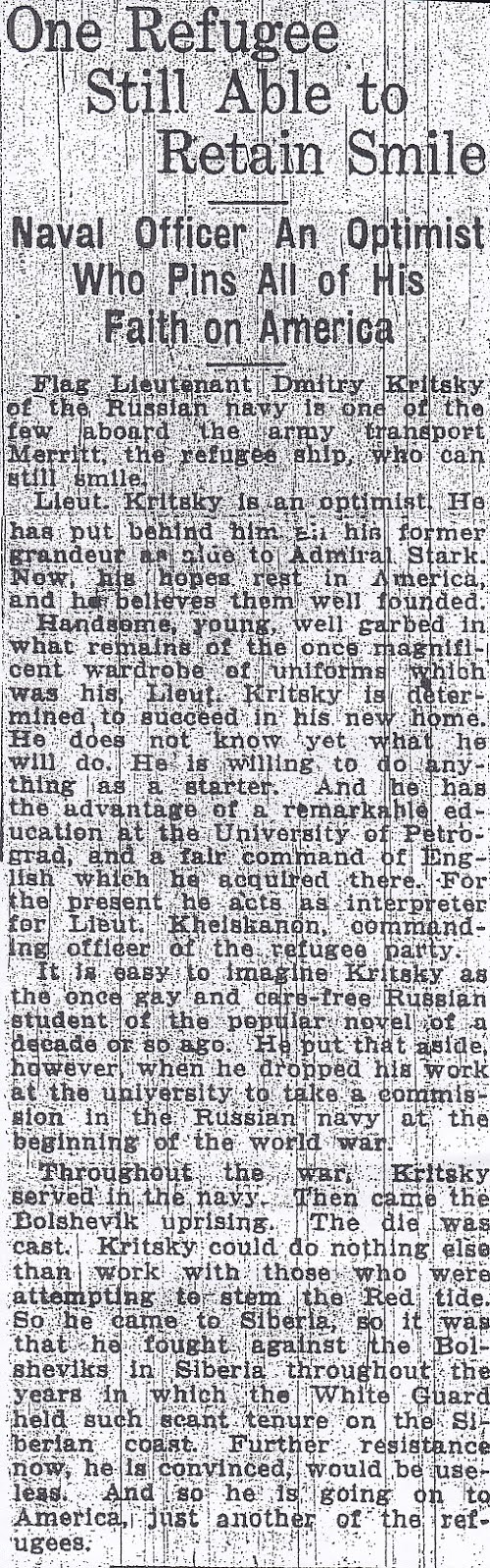
Russians, Departing on Transport for Mainland, Thank People of Hawaii

Honolulu Advertiser
June 23, 1923

Hollywood missed a rare chance yesterday morning for filming a "mob scene" of foreigners when the 450 Russian refugees who fled from the red terror in Siberia, marched off the transport pier and entered automobiles supplied by Honolulans for two hour ride around the city.  Sailors of the czar's old navy, officers of the old imperialistic and later revolutionary regimes, those who had once been well to do, and those who were and would be again artisans, mechanics, professional men, together with women and young people, women who typify the beauty of Russia, others with real broad faced ox-like features of the peasant class, all of whom walked down the gangway from the US Army Transport Merritt, which is conveying them from Manila to San Francisco.

Picturesque "Mob"

The were a "mob" that the movie directors would have grabbed as almost any European scene with a bunch of Russians, or those from its provinces, as the garb was distinctly that of Russia.  The sailor's and the soldiers still clung to their dinky little naval and military caps, the sailors to their bell mouth trousers, the soldiers to their boots with their trouser cuffs stuffed into them.  Soldiers and peasants wore the belted tunics, peasants even the women marched with military precision, for military life followed them from the cradle.  All were more or less drab garb, with little or no money, and no homes in Russia to depend upon with the future still hazy and relatives dead, some butchered the ruling regime in Russia.  There role as refugees has been a series of mishaps.

Morale Hard Hit  

Their morale has been hard hit and is now low so others aboard the Merritt state, and so ask, "Why shouldn't it be?  After all they have gone through, with nothing to do and knowing that they have not even a country they can call their own." 

Even pleasures, they seem to take seriously.  Although they saw from the Merritt's decks auto after auto line up on the streets, and were informed that they would be taken out on an auto ride, yet they came off the steamer with stolid faces.  There were some trepidation among many.  Some of the girls clung to their relatives, others to stalwarts young male companions of their exile.

With uncertainty ahead of them for years, their entry into the street yesterday still held some uncertainty, for there were soldiers everywhere.  They passed along through a sort of human lane, and there were soldiers everywhere.  They have seen nothing but soldiers in a more or less war-like attitude since 1914, nine long years, and often they were herded between lines of soldiers to fate they knew not what.