
USAT MERRITT 1923 ... On July 1, 1923, the army transport ship USAT Merritt out of Manila, Philippines, docked at Angel Island in the San Francisco Bay. It carried five hundred and twenty-six Russia "boat people" survivors of some seven thousand who had fled Vladivostok eight months previously as victorious Communist forces advanced on the last out post of resistance to the Bolshevik revolution.
Saturday, December 16, 2017

Monday, December 11, 2017

Monday, October 30, 2017

Russians, Departing on Transport for Mainland, Thank People of Hawaii
Honolulu Advertiser
June 23, 1923
Hollywood missed a rare chance yesterday morning for filming a "mob scene" of foreigners when the 450 Russian refugees who fled from the red terror in Siberia, marched off the transport pier and entered automobiles supplied by Honolulans for two hour ride around the city. Sailors of the czar's old navy, officers of the old imperialistic and later revolutionary regimes, those who had once been well to do, and those who were and would be again artisans, mechanics, professional men, together with women and young people, women who typify the beauty of Russia, others with real broad faced ox-like features of the peasant class, all of whom walked down the gangway from the US Army Transport Merritt, which is conveying them from Manila to San Francisco.
Picturesque "Mob"
The were a "mob" that the movie directors would have grabbed as almost any European scene with a bunch of Russians, or those from its provinces, as the garb was distinctly that of Russia. The sailor's and the soldiers still clung to their dinky little naval and military caps, the sailors to their bell mouth trousers, the soldiers to their boots with their trouser cuffs stuffed into them. Soldiers and peasants wore the belted tunics, peasants even the women marched with military precision, for military life followed them from the cradle. All were more or less drab garb, with little or no money, and no homes in Russia to depend upon with the future still hazy and relatives dead, some butchered the ruling regime in Russia. There role as refugees has been a series of mishaps.
Morale Hard Hit
Their morale has been hard hit and is now low so others aboard the Merritt state, and so ask, "Why shouldn't it be? After all they have gone through, with nothing to do and knowing that they have not even a country they can call their own."
Even pleasures, they seem to take seriously. Although they saw from the Merritt's decks auto after auto line up on the streets, and were informed that they would be taken out on an auto ride, yet they came off the steamer with stolid faces. There were some trepidation among many. Some of the girls clung to their relatives, others to stalwarts young male companions of their exile.
With uncertainty ahead of them for years, their entry into the street yesterday still held some uncertainty, for there were soldiers everywhere. They passed along through a sort of human lane, and there were soldiers everywhere. They have seen nothing but soldiers in a more or less war-like attitude since 1914, nine long years, and often they were herded between lines of soldiers to fate they knew not what.
June 23, 1923
Hollywood missed a rare chance yesterday morning for filming a "mob scene" of foreigners when the 450 Russian refugees who fled from the red terror in Siberia, marched off the transport pier and entered automobiles supplied by Honolulans for two hour ride around the city. Sailors of the czar's old navy, officers of the old imperialistic and later revolutionary regimes, those who had once been well to do, and those who were and would be again artisans, mechanics, professional men, together with women and young people, women who typify the beauty of Russia, others with real broad faced ox-like features of the peasant class, all of whom walked down the gangway from the US Army Transport Merritt, which is conveying them from Manila to San Francisco.
Picturesque "Mob"
The were a "mob" that the movie directors would have grabbed as almost any European scene with a bunch of Russians, or those from its provinces, as the garb was distinctly that of Russia. The sailor's and the soldiers still clung to their dinky little naval and military caps, the sailors to their bell mouth trousers, the soldiers to their boots with their trouser cuffs stuffed into them. Soldiers and peasants wore the belted tunics, peasants even the women marched with military precision, for military life followed them from the cradle. All were more or less drab garb, with little or no money, and no homes in Russia to depend upon with the future still hazy and relatives dead, some butchered the ruling regime in Russia. There role as refugees has been a series of mishaps.
Morale Hard Hit
Their morale has been hard hit and is now low so others aboard the Merritt state, and so ask, "Why shouldn't it be? After all they have gone through, with nothing to do and knowing that they have not even a country they can call their own."
Even pleasures, they seem to take seriously. Although they saw from the Merritt's decks auto after auto line up on the streets, and were informed that they would be taken out on an auto ride, yet they came off the steamer with stolid faces. There were some trepidation among many. Some of the girls clung to their relatives, others to stalwarts young male companions of their exile.
With uncertainty ahead of them for years, their entry into the street yesterday still held some uncertainty, for there were soldiers everywhere. They passed along through a sort of human lane, and there were soldiers everywhere. They have seen nothing but soldiers in a more or less war-like attitude since 1914, nine long years, and often they were herded between lines of soldiers to fate they knew not what.
Thursday, July 6, 2017
Russians Aboard USAT Merritt Under U.S. Laws
Admiral Stark Issues Strict Order
Upon Departure from Olongapo
Prior to the departure of the Russian refugees from Olongapo, Philippines on May 26, 1923 the following order was issued by Admiral Stark, who remained behind:
"1, During the whole passage all of the Russians must comply with military laws, rules, and regulations."
"2. In all cases of coaling or shifting coal or cargo, all of the men, without exception, must give a hand, seniors as leasers, juniors as laborers."
"3. All men also must help daily in cleaning up the ship."
"4. All those having firearms are to hand them over to the ship commander promptly and unquestionably. A receipt will be given and the arms returned on arrival in the United States."
"5. Keeping and consuming of alcoholic beverages is strictly and categorically forbidden."
Thousands of immigrants, some Russians included, are saving money to pay their passage to America. You are going free of charge. You should always remember this, and be thankful to Americans for their kindness to you with such treatment. The only way for you to pay them back is by being of irreproachable conduct and by carrying out the work of the ship's routine as directed by the authorities. You must remember that by your conduct during the passage you will be building up your recommendations and references, and consequently you will be met over there, in America, accordingly. Every one should be imbued with the sentiment of duty, and remember that any offense committed by one of you will be a dirty spot on the conduct of the whole group and bring harm to all Russians.
Honolulu Star Bulletin June 20, 1923


Monday, February 20, 2017
Angel Island Immigration Station Foundation


Monday, January 16, 2017
Commemorative Medal


"In the memory of our fathers who left their motherland forever." These words on this remarkable medal commemorate the 90th year anniversary of The Great Exodus of the White Russians from Vladivostok, October 22, 1922.
The artist is Kyra Tatarinoff, she and her husband Peter are members of the Russian Historical Society in Sydney, Australia. Peter's father, Sergei Tatarenoff, participated in this historical event. After spending come time in the Philippines, when the opportunity came to immigrate to Australia, he took it. This would be his new country and final home.
Monday, January 9, 2017
Holy Trinity Cathedral


The oldest Russian Orthodox parish in the western United States, founded in 1868. The cathedral was built in 1909 by the late Patriarch Tikhon of Russia, then Arch Bishop of San Francisco, after the original structure was destroyed during the 1906 earthquake. Expanded in 1934, restored and remodeled in 1979.

Tuesday, January 3, 2017


10 Year Reunion Photo

Picture taken in 1933, showing passengers of the USAT Merritt celebrating the ten year anniversary of arrival on July 1, 1923.
Monday, December 12, 2016
Russian Tells Story of Woe
Russian Tells Story Of Woe Among Refugees ... Interpreter Bares Thrilling Trip of 526 Members of Stark Party ... Survivors Brave Rigors of Tragic Flight From Soviet Hordes.
San Francisco Chronicle
July 2, 1923
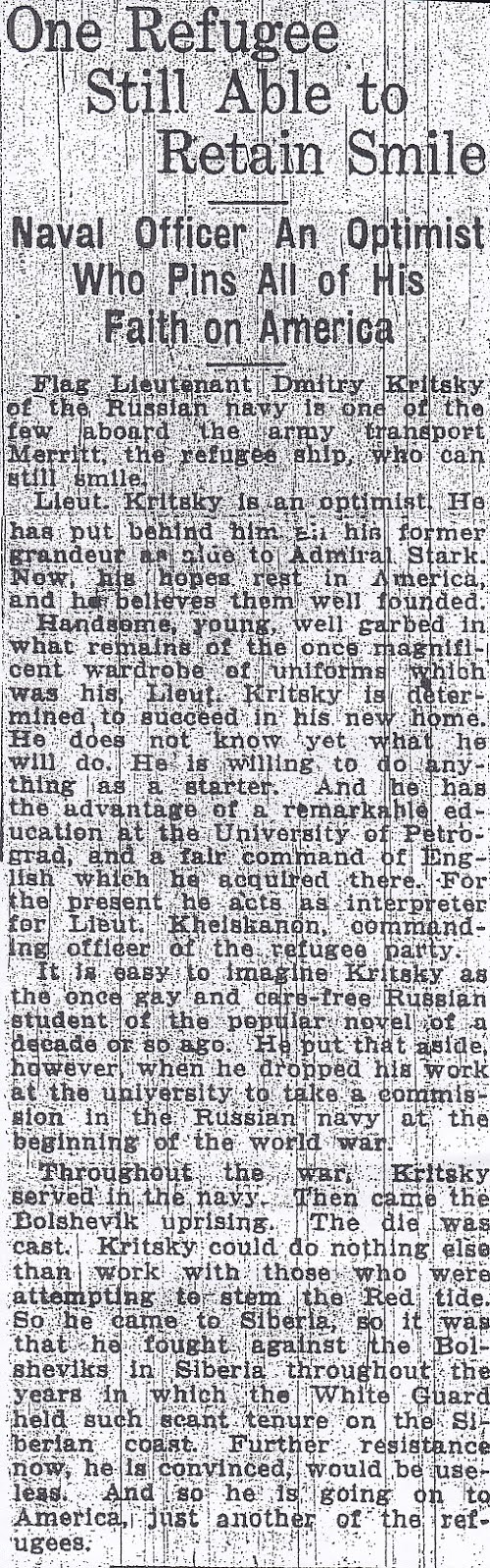
The story of the 526 refugees who arrived here yesterday on the United States transport Merritt is a touching tale, filled with adventure and excitement, as told by one of their number who had been with them from the start at Vladivostok on October 22, 1922 to the present day. He is Russian, speaks English. and on several points along the route he has acted as interpreter, even finding employment in that capacity during the four months the refugees stayed in Manila.
"It was was when the Bolsheviks came down on us in Vladivostok," he said, "that Admiral Yuri Stark of the White Russian Navy gathered every Russian sailor and soldier he could carry and took every boat in the harbor except except 3 Japanese icebreakers. Altogether about 14,000 of us started and some were in boats as short as 70 feet and of less then 200 tons displacement. The largest ship was not more then 700 tons. Some of the ships had no boilers, some no fuel, and some were without pieces of machinery."
Driven By Japanese
"First we went to Genzan in Chogan, that is Chinese for Korea, and stopped there, but the Japanese drove us away just as a great typhoon came up and in the great storm we lost a boat with more than 740 of our comrades. Some of the boats went to Shanghai, China from Korea and some turned about to go back to Russia again, so great did the difficulties seem. In China, he continued we were given some fuel, some coal. After we had tried to use it we found it was more nearly dirt or trash, but kept the the ships going, though and many had to be towed and otherwise helped. We lost another boat on a reef on this trip and seventeen more were killed, but they were as nothing compared to the number we lost since starting who had deserted or who had tried to make their way back to Russia. Finally eleven ships got to Manila with about 800 refugees. We worked there building houses, and I worked at interpreting. There were 120 women and 35 children and the Red Cross cared for them and us for more than four months."
Members Mutiny
"We were at Mariveles and Olongapo, and while there some got drunk and some mutinied. Our own officers discovered the mutiny and sixteen were sentenced to prison. Then we left Manila on this ship, the USAT Merritt. We were to run the ship ourselves, to do the work of the crew and firemen. But when about 200 or 300 miles out, we found we were unable to work at the fires. I was one who tried to work in the heat but could not do it and became sick, and could not work. Captain Fuller had the Filipinos stoke the fires, and we had to return. At Manila, we left Admiral Stark, who might gone to Finland, and Lt.General Peter Heiskanin took command. We also left our ships, but they were all battered or useless or lost. Some tried to return to Russia."
Leave For San Francisco
"From Manila we went to Nagasaki and from Nagasaki we left for San Francisco. The first day from Nagasaki a 5 month old baby died on the ship. Otherwise our trip on the USAT Merritt had been without incident and had been the least of the trying times on our long journey. We discovered a Filipino stowaway whom the captain put ashore on some island after we were a ways out. Finally we came here after 38 days at sea."
This man has no friends in San Francisco or the rest of America and does not know what he is going to do. He is very glad be get here, and said he knows he will find something useful to work at.
Last of The White Army and Navy
San Francisco, July 1, 1923 - A little bit of Russia drifted in through the Golden Gate this morning on the US Army Transport Merritt, 526 men, women and children refugees, the last of the white army and white navy. For two years they have been seeking a home. For two years they have wandered from port to port, enduring hunger and disease and hardships innumerable, nowhere welcomed, nowhere aided until America took note of them and held out a helping hand.
Some of them wore the uniform of the armies of the Czar, of Generals Denikin and of Wrangel. Some of them wore the clothes the American Red Cross gave them in Manila. Lieutenant General Peter Heieskanin is in charge of the refugees. The Rev. Serge Denisoff is the chaplain. These and Prince Alexis Chegodaieff, a powerful figure in the czar’s regime, are the important influential men among these people. There are 254 single men, 70 married couples, 87 single women and 45 children. Five of the children have lost both father and mother.
New York Times
Some of them wore the uniform of the armies of the Czar, of Generals Denikin and of Wrangel. Some of them wore the clothes the American Red Cross gave them in Manila. Lieutenant General Peter Heieskanin is in charge of the refugees. The Rev. Serge Denisoff is the chaplain. These and Prince Alexis Chegodaieff, a powerful figure in the czar’s regime, are the important influential men among these people. There are 254 single men, 70 married couples, 87 single women and 45 children. Five of the children have lost both father and mother.
New York Times

Saturday, December 10, 2016
Russian Refugees Landing Today
Russian Refugees Landing Today Pose A Problem ... City And Government Officials Wonder What To Do With Them ... Each Must Have Cash ... Local Officials Declare That those Coming Are Guests Of The Nation.
San Francisco Chronicle
Chronicle Shipping News And Travel
Sunday, July 1, 1923
Just what is to be done with 526 Russian refugees due in San Francisco today on the US Army transport Merritt is a problem facing Immigration Commissioner John D. Nagle. The only instructions he has received from Washington DC are to examine and admit them the same as other immigrants.
If they can pass the tests they may stay, if not they may be ported. Where is not exactly known, for they have no homes to be returned to. They were driven out of Siberia some months ago by the present government because they were aristocrats of the old regime. At every port they entered the authorities refused to admit them. Rejected everywhere in Asia the refugee fleet was almost shipwrecked off the Philippines, where the United States Government took pity on them and allowed the Russians to land, and is now bringing them to San Francisco at federal government expense.
Must Have Money
One of the provisions of immigration law is that immigrants must either have money or have friends or relatives in America who will guarantee the new arrivals will not become public charges. The refugees are penniless and only a few of them have friends in America. A small number are tradesmen and might make a living here, but it is said the majority are aristocrats who have never done a day's work and never will. They refused to work on the transport radio messages stated.
As there are not not sufficient accommodations at Angel Island, the refugees will not be taken there for examination, rather the tests will be conducted on board the ship as rapidly as possible. To avoid delay, the work will be started as soon as the Merritt docks at noon today.
Must be Examined
"We can't tell what we will do with the refugees until after they have been examined," said Commissioner Nagle yesterday. "Each case will have to taken up separately."
Municipal authorities and the San Francisco Red Cross have informed headquarters in Washington DC that the city should not be called upon to look after the refugees alone, the Russians being "guests" of the Nation and not of the city.
The Russian Relief Society yesterday agreed to take temporary care of all refugees who have no friends or relatives in the United States. All of them who are not released at once to their friends or relatives will be taken to the army barracks at Fort McDowell until their cases can be disposed of.
Subscribe to:
Posts (Atom)